
First five multiples worksheets 4th Grade Math · Factors and Multiples
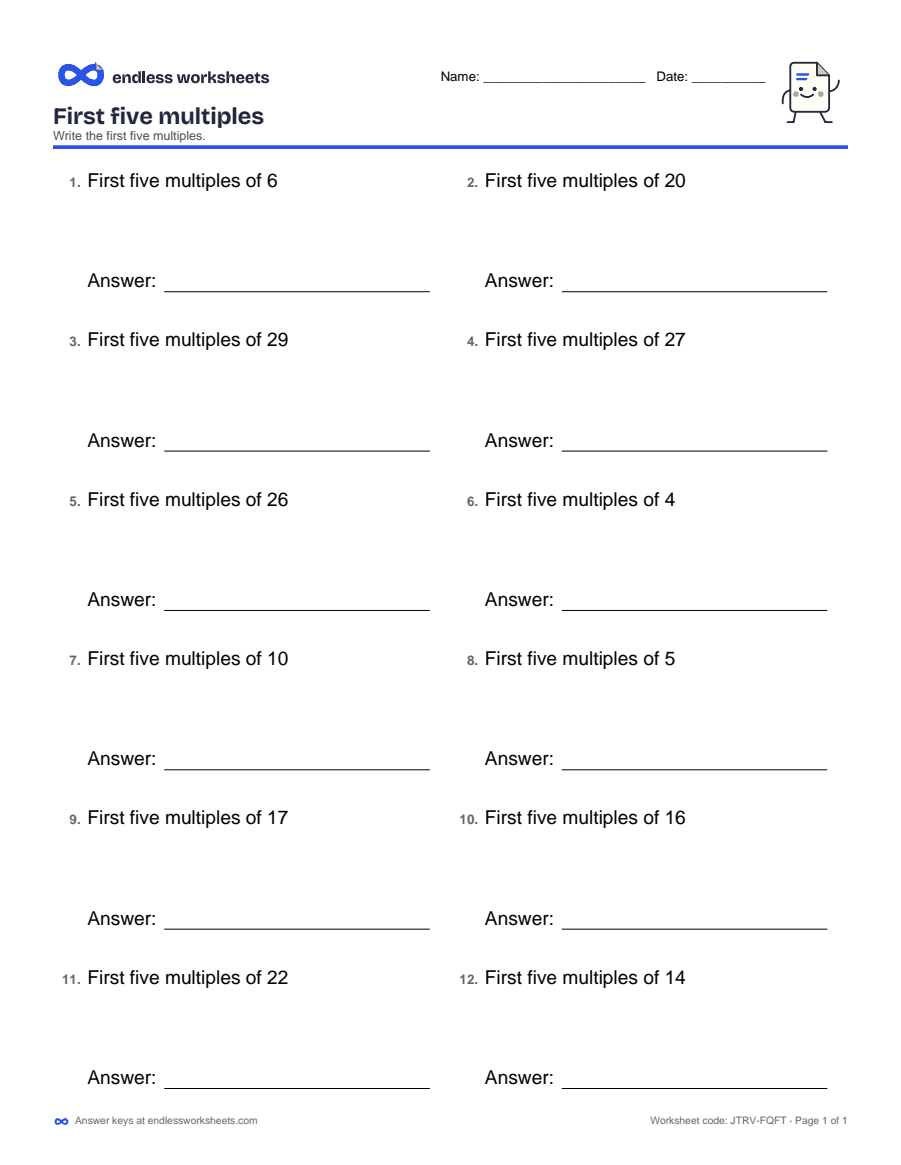
The first five multiples of a number, such as 6, 12, 18, 24, 30.
Make it yours
12 problems · 1 page, plus an answer key
Or print the sample shown (1 page): worksheet · answer key
How it works: a quick refresher
The rules this worksheet practices, then one problem worked from start to finish.
| Strategy | How it works |
|---|---|
| A factor divides evenly | 6 is a factor of 42 because 42 ÷ 6 = 7, with nothing left over. 5 is not, because 42 ÷ 5 leaves a remainder. |
| 1 and the number itself count | Every whole number greater than 1 has at least 1 and itself as factors. The factors of 12 are 1, 2, 3, 4, 6, 12. |
| List factors in order | Start at 1 and stop at the number. Do not skip a factor, and do not write the same one twice. |
| Multiples count by the number | The first five multiples of 4 are 4, 8, 12, 16, 20. The number itself is the first multiple. |
| Prime has exactly two factors | A prime number has only 1 and itself. 7 is prime. 9 is composite because 1, 3 and 9 are factors. 1 is neither. |
Worked example
List all the factors of 12.
- 112 = 2 × 2 × 3.
- 2The pairs are 1 and 12, 2 and 6, 3 and 4.
- 3In order, the factors are 1, 2, 3, 4, 6, 12.
Ready-made versions
Three fixed versions you can link to or share. Each is a PDF with its own answer key.
- First five multiples worksheets, version 1Worksheet PDFAnswer key PDF
- First five multiples worksheets, version 2Worksheet PDFAnswer key PDF
- First five multiples worksheets, version 3Worksheet PDFAnswer key PDF
Grade level and standard
Written for 4th grade math (operations). It practices what Common Core standard CCSS 4.OA.B.4 describes, and also works as review in later grades. How we check standards and answers
Common questions
- Is there an answer key?
- Yes. Every worksheet has a matching answer key with each answer worked on the same grid or layout as the question. The worksheet code printed at the bottom of each page pairs a sheet with its key.
- Why is 1 not prime or composite?
- A prime number has exactly two different factors, 1 and itself. 1 has only one factor, so it is neither. These sheets start at 2.
- Is 4 a multiple of 4, or does the list start at 8?
- 4 is the first multiple of 4. The first five are 4, 8, 12, 16 and 20.
- How many different versions are there?
- As many as you need. Each time you press the button the problems are generated fresh, so you can print a different version for every student, a retake, or another night of practice.
- Are the worksheets free?
- Yes. They are free to print and copy for your home or classroom, with no sign-up.
Was this worksheet helpful?
Tell us what worked or what didn't. Need a different skill? Request a worksheet.
More 4th grade math worksheets
- All factors and multiples worksheets
- All factors
- Prime or composite
- Is it a factor?
- Rounding Multi-Digit Numbers
- Multi-Digit Addition and Subtraction
- Multi-Digit Multiplication
- Long Division
- Number Hunt: Sums and Products
- Equivalent Fractions
- Compare Fractions with Different Numerators and Denominators
- Add and Subtract Fractions with Like Denominators
- Multiply a Fraction by a Whole Number
- Comparing Decimals
- All 4th grade math