
8th Grade Math · Pythagorean Theorem
Find the hypotenuse Worksheets
Fresh practice, ready to print. Answer key included.
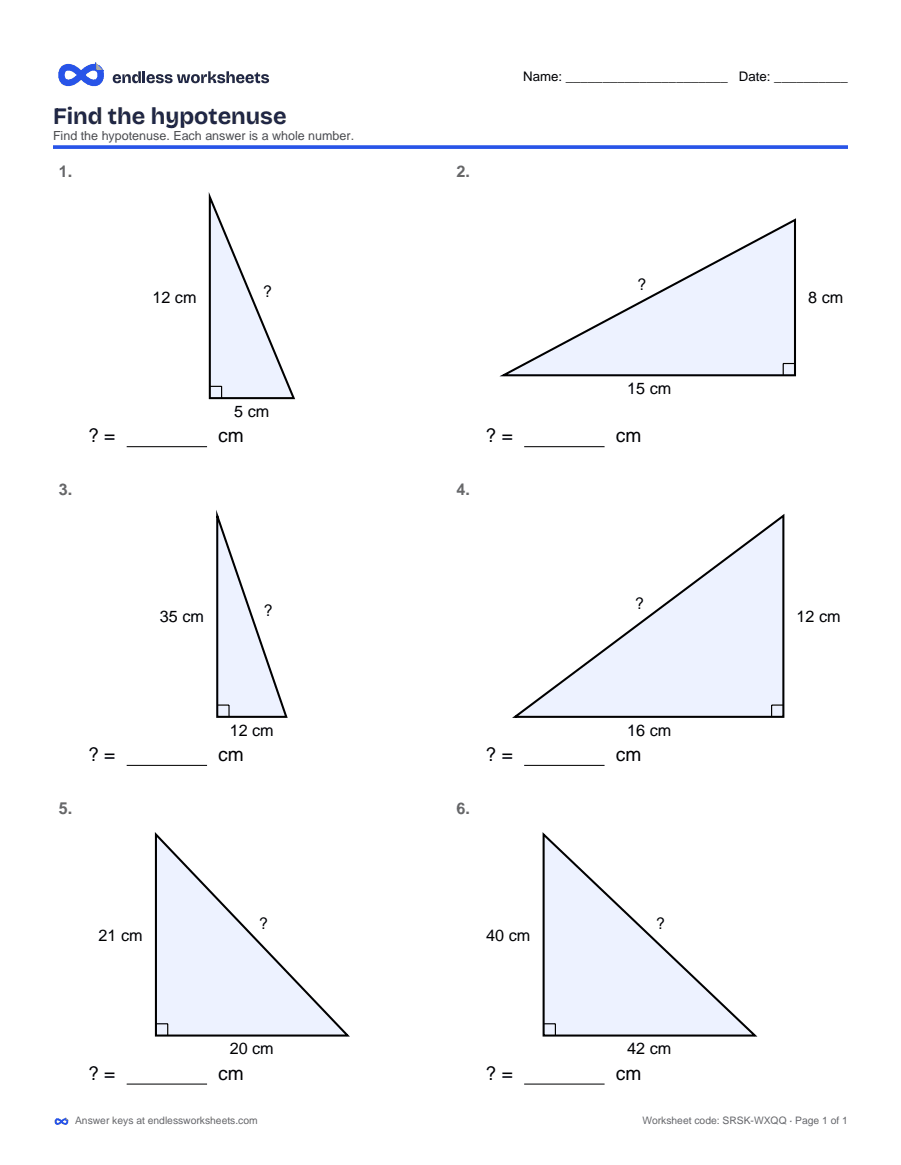
Both legs are given, such as 6 cm and 8 cm. The hypotenuse is a whole number.
Make it yours
Or start with a ready-made version.
How it works: a quick refresher
The rules this worksheet practices, then one problem worked from start to finish.
| Strategy | How it works |
|---|---|
| The right angle | The square mark shows the right angle. The side opposite it is the hypotenuse, and it is the longest side. |
| The theorem | a² + b² = c². a and b are the legs. c is the hypotenuse. |
| Find the hypotenuse | Square each leg, add, then take the square root. 6² + 8² = 36 + 64 = 100, and the square root of 100 is 10. |
| Find a leg | Subtract the known leg's square from the hypotenuse's square, then take the square root. 13² − 12² = 25, and the square root of 25 is 5. |
| Round at the end | When the square root is not a whole number, round the length to the nearest tenth. The square root of 13 is about 3.605, so the side is 3.6 cm. |
Worked example
A right triangle has legs of 6 cm and 8 cm. Find the hypotenuse.
- 1The right angle is between the sides of 6 cm and 8 cm, so the side marked ? is the hypotenuse.
- 2Square the legs: 6² = 36 and 8² = 64.
- 3Add: 36 + 64 = 100.
- 4The square root of 100 is 10, so the hypotenuse is 10 cm.
Ready-made versions
Three fixed versions you can link to or share. Each is a PDF with its own answer key.
- Find the hypotenuse Worksheets, version 1Worksheet PDFAnswer key PDF
- Find the hypotenuse Worksheets, version 2Worksheet PDFAnswer key PDF
- Find the hypotenuse Worksheets, version 3Worksheet PDFAnswer key PDF
Grade level and standard
Written for 8th grade math (geometry) and aligned to CCSS 8.G.B.7. It also works as review in later grades.
Common questions
- Is there an answer key?
- Yes. Every worksheet has a matching answer key with each answer worked on the same grid or layout as the question. The worksheet code printed at the bottom of each page pairs a sheet with its key.
- Which side is the hypotenuse?
- The side across from the right angle, opposite the square mark. It is never one of the two sides that form the right angle, and it is the longest of the three.
- Why do some answers have a decimal?
- Most side lengths are not whole numbers. The square root of 13 is about 3.605, which is 3.6 to the nearest tenth. The nearest-tenth section is the one that asks for that rounding.
- How many different versions are there?
- About a million per skill. Each time you press the button the problems are generated fresh, so you can print a different version for every student, a retake, or another night of practice.
- Are the worksheets free?
- Yes. They are free to print and copy for your home or classroom, with no sign-up.
Was this worksheet helpful?
Tell us what worked or what didn't. Need a different skill? Request a worksheet.