3rd Grade Math · Division Facts
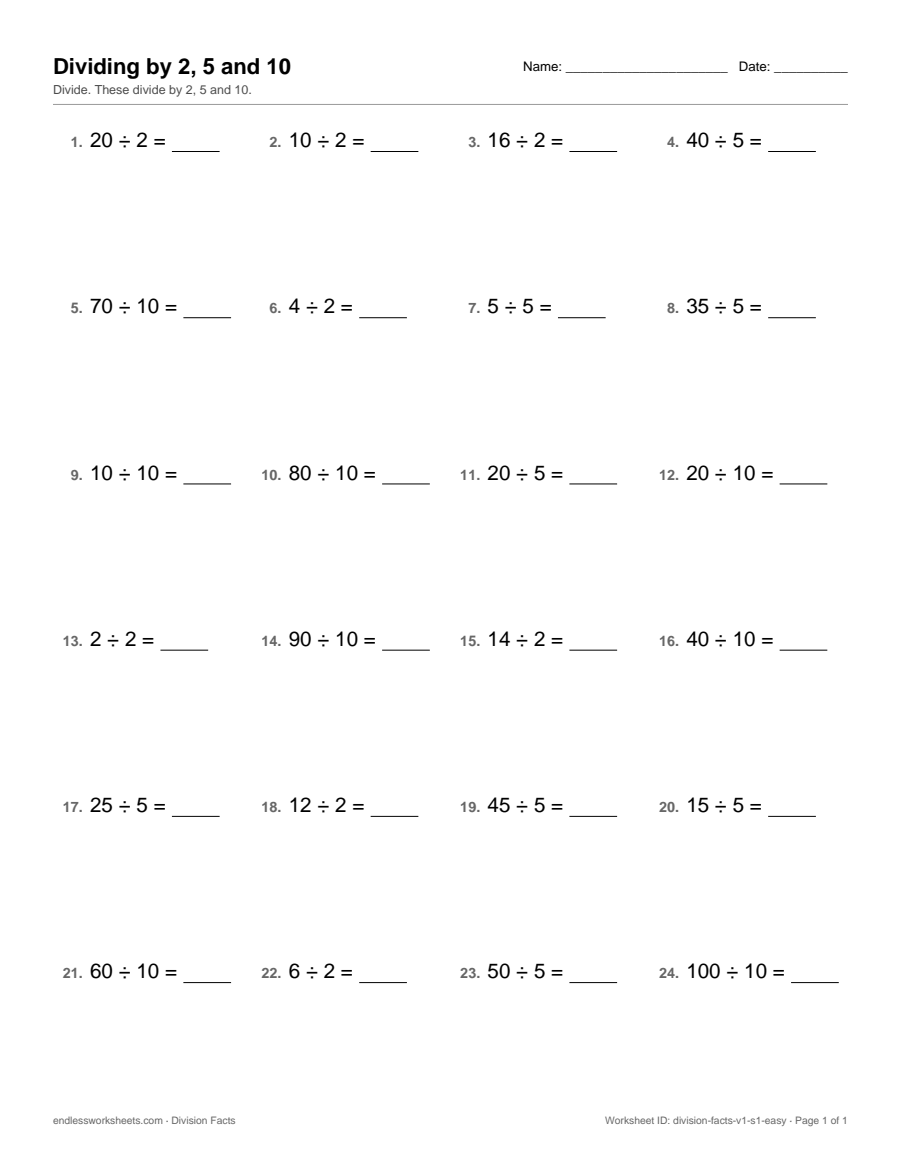
Dividing by 2, 5 and 10 Worksheets
Free and printable, with a full answer key. Every worksheet is generated fresh, so you can hand a different version to every student.
Facts such as 40 ÷ 5 and 18 ÷ 2.
Or start with a ready-made version:
How it works: a quick refresher
For the adult at the table. These are the rules the worksheet practices, followed by one problem worked from start to finish.
| Strategy | How it works |
|---|---|
| Think multiplication | For 56 ÷ 8, ask what times 8 makes 56. 7 × 8 = 56, so the answer is 7. |
| Fact families | 6 × 4 = 24 gives 24 ÷ 4 = 6 and 24 ÷ 6 = 4. |
| Dividing by 2 is halving | 18 ÷ 2 is half of 18, which is 9. |
| Dividing by 10 | Take away the zero: 70 ÷ 10 = 7. |
Worked example
Find 42 ÷ 7.
- Ask: what number times 7 makes 42?
- Count by sevens if needed: 7, 14, 21, 28, 35, 42. That is six sevens.
- So 42 ÷ 7 = 6.
Ready-made versions
Three fixed versions you can link to or share. Each is a PDF with its own answer key.
- Dividing by 2, 5 and 10 Worksheets, version 1Worksheet PDFAnswer key PDF
- Dividing by 2, 5 and 10 Worksheets, version 2Worksheet PDFAnswer key PDF
- Dividing by 2, 5 and 10 Worksheets, version 3Worksheet PDFAnswer key PDF
Grade level and standard
Written for 3rd grade math (operations) and aligned to CCSS 3.OA.C.7. It also works as review in later grades.
Common questions
- Is there an answer key?
- Yes. Every worksheet has a matching answer key with each answer worked on the same grid or layout as the question. The worksheet ID printed at the bottom of each page pairs a sheet with its key.
- Should we learn division before the times tables are solid?
- It works best alongside or just after multiplication, because each division fact is answered with a multiplication fact.
- Are there remainders?
- No. Every problem divides evenly. Remainders come with long division in 4th grade.
- How many different versions are there?
- About a million per skill. Each time you press the button the problems are generated fresh, so you can print a different version for every student, a retake, or another night of practice.
- Are the worksheets free?
- Yes. They are free to print and copy for your home or classroom, with no sign-up.