
3-digit ÷ 2-digit, no remainder worksheets 5th Grade Math · Long Division with Two-Digit Divisors
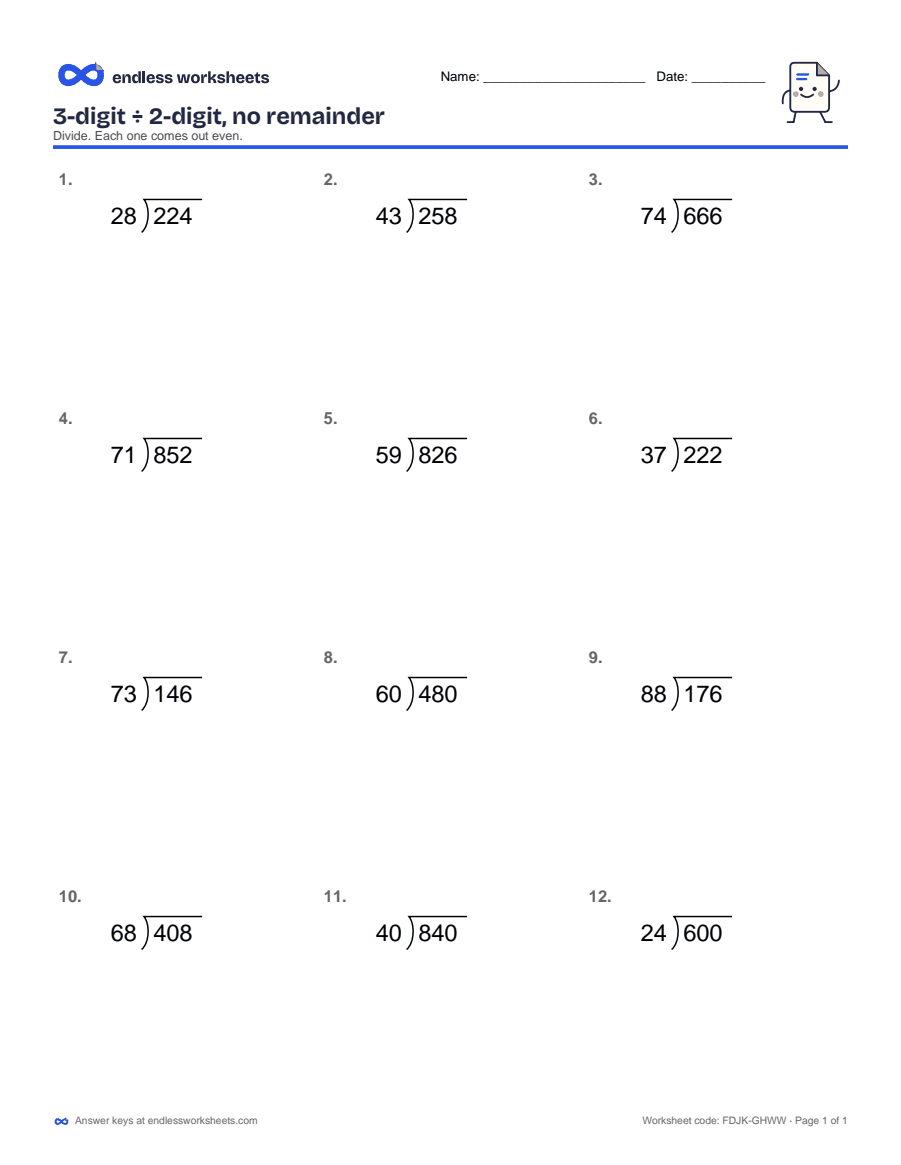
Problems such as 336 ÷ 14, which come out even.
Make it yours
12 problems · 1 page, plus an answer key
Or print the sample shown (1 page): worksheet · answer key
How it works: a quick refresher
The rules this worksheet practices, then one problem worked from start to finish.
| Strategy | How it works |
|---|---|
| Estimate the first digit | Ask how many times the divisor fits into the first two or three digits. 14 goes into 33 two times, not one and not three. |
| Multiply, subtract, bring down | After each quotient digit, multiply it by the divisor, subtract, and bring down the next digit. |
| The remainder is smaller than the divisor | If it is not, the last quotient digit can go up by one. |
| A zero in the quotient matters | If the divisor does not fit into the current number, write 0 in the quotient and bring down the next digit. |
| Check by multiplying | quotient × divisor + remainder should equal the dividend. |
Worked example
Find 336 ÷ 14.
- 114 goes into 33 two times. Write 2 above the 3.
- 22 × 14 = 28, and 33 − 28 = 5. Bring down the 6 to make 56.
- 314 goes into 56 four times. 4 × 14 = 56, and 56 − 56 = 0.
- 4336 ÷ 14 = 24. Check: 24 × 14 = 336.
Ready-made versions
Three fixed versions you can link to or share. Each is a PDF with its own answer key.
- 3-digit ÷ 2-digit, no remainder worksheets, version 1Worksheet PDFAnswer key PDF
- 3-digit ÷ 2-digit, no remainder worksheets, version 2Worksheet PDFAnswer key PDF
- 3-digit ÷ 2-digit, no remainder worksheets, version 3Worksheet PDFAnswer key PDF
Grade level and standard
Written for 5th grade math (place value). It practices what Common Core standard CCSS 5.NBT.B.6 describes, and also works as review in later grades. How we check standards and answers
Common questions
- Is there an answer key?
- Yes. Every worksheet has a matching answer key with each answer worked on the same grid or layout as the question. The worksheet code printed at the bottom of each page pairs a sheet with its key.
- Why do some divisors end in zero and most do not?
- A divisor such as 20 or 30 is a fair problem, but it is an easier one. Most problems use a divisor that does not end in zero so the estimate takes real work.
- Does the key show the long-division work?
- The key shows the quotient and any remainder. Check the work by multiplying: the quotient times the divisor, plus the remainder, equals the dividend.
- How many different versions are there?
- As many as you need. Each time you press the button the problems are generated fresh, so you can print a different version for every student, a retake, or another night of practice.
- Are the worksheets free?
- Yes. They are free to print and copy for your home or classroom, with no sign-up.
Was this worksheet helpful?
Tell us what worked or what didn't. Need a different skill? Request a worksheet.
More 5th grade math worksheets
- All long division with two-digit divisors worksheets
- 4-digit ÷ 2-digit, no remainder
- With remainders
- Mixed practice
- Multi-Digit Multiplication Fluency
- Decimal Operations
- Volume of Rectangular Prisms
- Add and Subtract Fractions with Unlike Denominators
- Multiply Fractions
- Dividing Unit Fractions
- Plotting Points in the First Quadrant
- Order of Operations
- All 5th grade math