
5th Grade Math · Decimal Operations
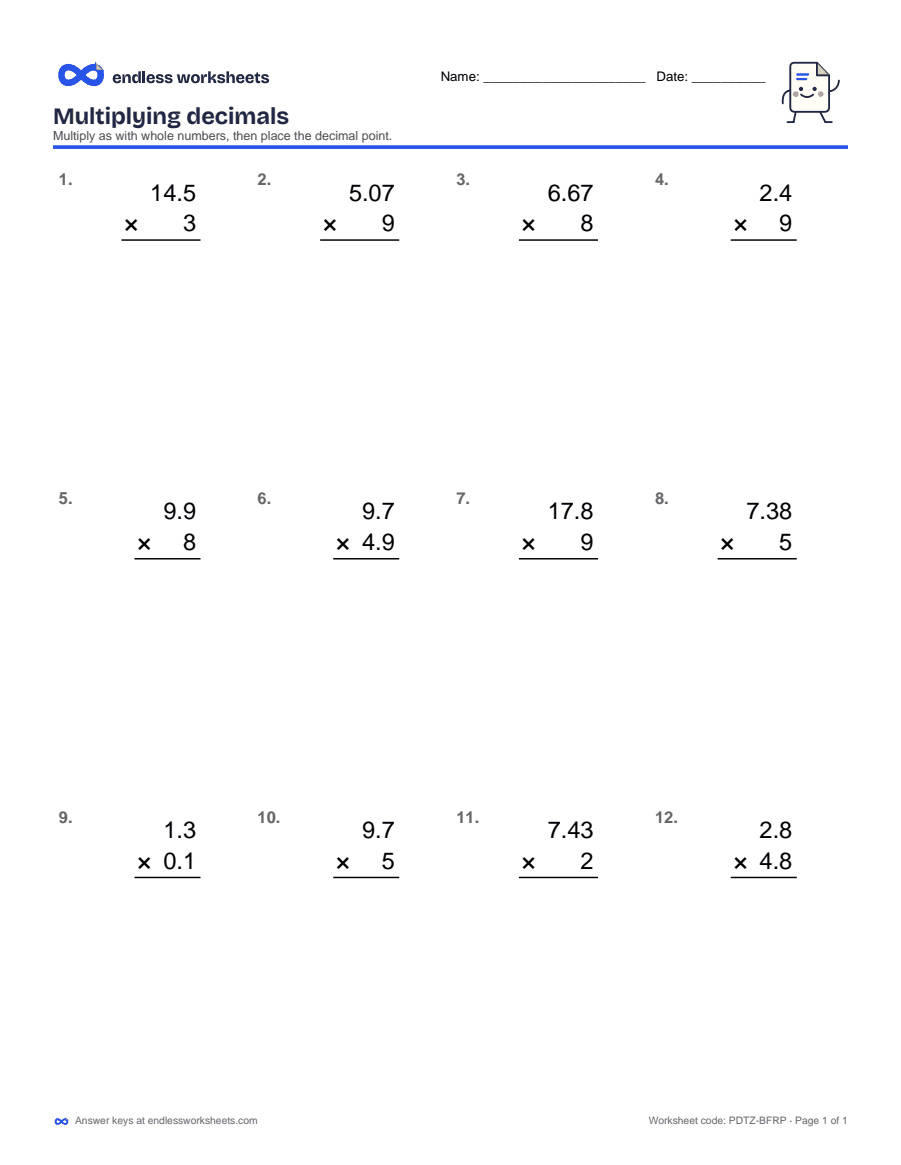
Multiplying decimals Worksheets
Fresh practice, ready to print. Answer key included.
A decimal times a whole number, or tenths times tenths, such as 2.5 × 1.3.
Make it yours
Or start with a ready-made version.
How it works: a quick refresher
The rules this worksheet practices, then one problem worked from start to finish.
| Strategy | How it works |
|---|---|
| Line up the points | To add or subtract, write the numbers so the decimal points are in one column. |
| Fill empty places | 9.2 − 4.37: write 9.2 as 9.20 so every place has a digit. |
| Count decimal places | To multiply, ignore the points, multiply, then give the product as many decimal places as both factors together: 2.5 × 1.3 → 25 × 13 = 325 → 3.25. |
| Point straight up | Dividing by a whole number, put the decimal point in the quotient directly above the one in the dividend. |
| Make the divisor whole | 3.6 ÷ 0.4: move both points one place right to get 36 ÷ 4 = 9. |
| Estimate | 2.5 × 1.3 is about 3 × 1 = 3, so 3.25 is reasonable. |

Worked example
Find 2.5 × 1.3.
- 1Ignore the decimal points and multiply the whole numbers: 25 × 13.
- 225 × 3 = 75 and 25 × 10 = 250, so 25 × 13 = 325.
- 32.5 has one decimal place and 1.3 has one, so the product has two: 3.25.
- 4Check with an estimate: about 3 × 1 = 3. 3.25 is close.
Ready-made versions
Three fixed versions you can link to or share. Each is a PDF with its own answer key.
- Multiplying decimals Worksheets, version 1Worksheet PDFAnswer key PDF
- Multiplying decimals Worksheets, version 2Worksheet PDFAnswer key PDF
- Multiplying decimals Worksheets, version 3Worksheet PDFAnswer key PDF
Grade level and standard
Written for 5th grade math (place value) and aligned to CCSS 5.NBT.B.7. It also works as review in later grades.
Common questions
- Is there an answer key?
- Yes. Every worksheet has a matching answer key with each answer worked on the same grid or layout as the question. The worksheet code printed at the bottom of each page pairs a sheet with its key.
- Why are the subtraction problems printed with different numbers of decimal places?
- On purpose. Lining up 9.2 and 4.37 and filling the empty place with a zero is the part students most often get wrong, so the worksheet practises it.
- Does my child need to line up the decimal points when multiplying?
- No. Multiplication is set out like whole numbers, right-aligned. The decimal point is placed at the end by counting decimal places.
- How many different versions are there?
- About a million per skill. Each time you press the button the problems are generated fresh, so you can print a different version for every student, a retake, or another night of practice.
- Are the worksheets free?
- Yes. They are free to print and copy for your home or classroom, with no sign-up.
Was this worksheet helpful?
Tell us what worked or what didn't. Need a different skill? Request a worksheet.